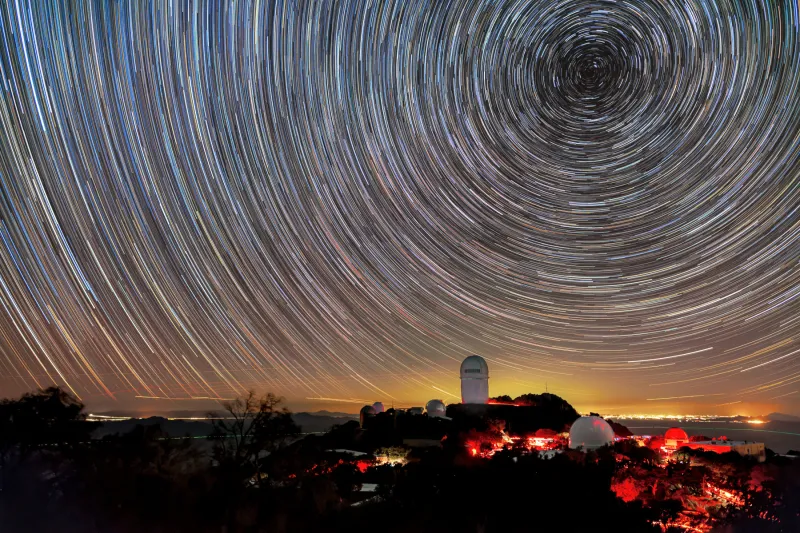
The prize was awarded for greatly advancing our understanding of how the universe began, evolved, and will continue to grow in the future. DESI is installed on top of the Mayall 4-meter telescope at Kitt Peak National Observatory in Arizona. Mayall launched in 1973, and considering the ever-growing sizes of telescopes (Vera Rubin’s mirror is 8.4 meters wide), that might not sound so impressive. There’s also the old bit of physics wisdom that claims bigger is better. But this telescope, which the community had “moved on [from],” was perfectly suited for DESI’s mission, Klaus Honscheid said, a physicist at Ohio State University.
“The way we do this is we have 5,000 little robots—not the robots in science fiction, but these pencil-sized objects that can be remotely controlled, with optical fibers at the tip,” Honscheid explained. “You know from imaging where a galaxy is, and then you move the fiber’s tip to exactly that location; you do that with all 5,000 of them and then move on to the next exposure.”