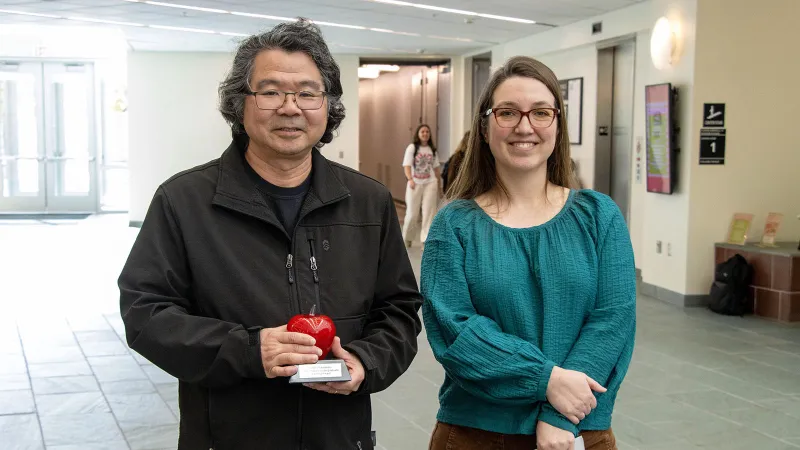
Prof. Roland Kawakami Wins 2026 Undergraduate Teaching Award
Professor Roland Kawakami was surprised on April 28, 2026 during the Physics Spring Picnic when Professor Annika Peter, Vice-Chair for Undergraduate Studies, announced to the audience that Prof. Kawakami won the 2026 Physics Undergraduate Teaching Award. This award is given annually and is voted on by undergraduate physics and engineering physics majors.
Prof. Kevin Singh awarded OFRN Research Funding in Quantum Technologies
Professor Kevin Singh, recipient of the John W. Wilkins Endowed Professorship of Physics, has been awarded $1.1 million in new research funding through the Ohio Federal Research Network (OFRN). This award is a part of OFRN's Round 7 projects, which include $10.198 million to support seven collaborative research and development projects across Ohio's academic and industry partners. Dr. Singh leads the project titled "Photonic Interfaces for Atom-based Quantum Processors," and includes collaboration with SRICO, Inc., Professor Steven Olmschenk at Denison University, and federal partners at the Air Force Research Laboratory (AFRL) and NASA John Glenn Research Center.
Prof. Geraldine Cochran Featured in Physics Today
Professor Geraldine Cochran (The Ohio State University) and Professor Suzanne White Brahmia (University of Washington) rethink what it means to be "ready" in physics and highlights how new pathways can support all learners in Physics Today. Who gets to take physics shouldn’t be dependent on whether their high school offered calculus. This article explores how traditional placement tests and rigid prerequisites create barriers for talented students. Additionally, the article highlights innovative programs and courses that expand access, build quantitative skills, and open door to STEM careers for all. Read more on Physics Today.
Prof. Louis DiMauro and Chemistry Researchers Published in PNAS
Professor Louis DiMauro, Director of the Institute for Optical Science and Hagenlocker chair and professor in the Department of Physics, is the corresponding author of a new article published in the Proceedings of the National Academy of Sciences (PNAS). The study, “Solvation-induced local structure in liquids probed by high-harmonic spectroscopy,” was co-authored by collaborators from Ohio State’s Department of Physics and Department of Chemistry and Biochemistry, as well as partners at Louisiana State University.
Prof. Mike Lisa Recognized as Distinguished University Professor
The Department of Physics is proud to celebrate Professor Michael Lisa, who was named a 2025 Distinguished University Professor, the highest faculty honor awarded by The Ohio State University. A Distinguished Professor of Physics, Mike Lisa is internationally recognized for his groundbreaking research on quark-gluon plasma, an extreme state of matter believed to have existed just moments after the Big Bang. His pioneering contributions to nuclear and particle physics, combined with his outstanding leadership and dedication to student mentorship, have earned him numerous national and international honors throughout his career. Since joining Ohio State in 1996, Mike Lisa has also become known as an exceptional educator and mentor, receiving both undergraduate teaching and research mentoring awards. Read more about this prestigious recognition.
DESI awarded 2026 Berkeley Prize
The Department of Physics and Department of Astronomy are proud to celebrate the contributions of Ohio State researchers to the Dark Energy Spectroscopic Instrument (DESI) Collaboration, which has been awarded the 2026 Lancelot M. Berkeley–New York Community Trust Prize for Meritorious Work in Astronomy. The collaboration was recognized by the American Astronomical Society for producing the largest 3D map of the universe ever created and for groundbreaking research investigating the nature of dark energy and the accelerating expansion of the universe. Ohio State faculty members Klaus Honscheid, Ashley Ross, Paul Martini, and David Weinberg, along with numerous staff, students, and researchers, played key roles in this international effort. The award recognizes DESI's transformative impact on modern cosmology and its potential to reshape our understanding of how the universe evolves over time. Read more about the award and Ohio State's involvement here.
Prof. Daniel Brandenburg elected new chair of the RHIC
Professor Daniel Brandenburg has been elected as the new chair of the Relativistic Heavy Ion Collider (RHIC) and AGS users executive committee. The purpose of this committee is to "provide an organized channel for the interchange of information between the Laboratory administration and those who use BNL's nuclear, high-energy, and heavy-ion facilities. Representing a wide spectrum of research workers, the group will make known to the BNL administration the needs and desires of those actively engaged in leading research projects, while providing a means for BNL to inform them of current and future plans for the Laboratory. It is expected that this will enable the Laboratory administration better to evaluate the needs of its users so they can more efficiently plan their use of Laboratory facilities."
Three Department of Physics Faculty elected to 2024 Class of AAAS Fellows
Department of Physics Professors John Beacom, Jeanie Lau, and Roland Kawakami are among the nine total OSU scientists who have been elected to the 2024 class of American Association for the Advancement of Science (AAAS) Fellows. The AAAS Fellowship, recognizing scientifically or socially distinguished efforts to advance science or its applications, is one of the most prestigious honors a U.S. scientist can receive. Fellows are elected by their academic peers.
- John Beacom, professor of physics and astronomy. For distinguished contributions to the fields of nuclear and particle astrophysics, particularly regarding neutrinos.
- Chun Ning Jeanie Lau, professor of physics. For distinguished experimental contributions to the field of 2D van der Waals materials, leading to new insights into the thermal, mechanical and electronic properties, and emergent phases in few-layer graphene.
- Roland Kenji Kawakami, professor of physics. For seminal contributions to spintronics and magnetism in two-dimensional materials, and for the investigation of epitaxial magnetic films and heterostructures using molecular beam epitaxy and surface-sensitive characterizations.
Prof. Chris Hill and MilliQan Experiment featured in APS TV short film
Chris Hill, professor of physics and co-spokesperson of the milliQan experiment, and Graduate Student Mike Carriage were featured in short film about the milliQan experiment. This short film was presented at the 2025 APS Global Physics Summit.
Prof. Mike Lisa named a recipient of the 2025 Excellence in Undergraduate Research Mentoring Award
Professor Mike Lisa has been named a recipient of the 2025 Excellence in Undergraduate Research Mentoring Award! This is an annual award given by Undergraduate Research & Creative Inquiry in the Office of Academic Enrichment. The award “honors individuals who have demonstrated success in mentoring undergraduates in their research and/or creative inquiry endeavors, as nominated by the students they have impacted with their exceptional mentoring.” Over 50 mentors were nominated and four were selected to be recognized this
Prof. K.K. Gan re-elected Chair of the Institute Board of the Pixel detector of the ATLAS experiment
Professor K.K. Gan of the Department of Physics has been reelected Chair of the Institute Board of the Pixel detector of the ATLAS experiment. The experiment was designed to study proton-proton collisions at the Large Hadron Collider (LHC) at European Organization for Nuclear Research, known as CERN, in Geneva, Switzerland. LHC collides protons with the highest energy and intensity in the world. The ATLAS experiment, together with the CMS experiment, discovered the Higgs boson which led to the 2013 Nobel Prize. ATLAS is a gigantic scientific instrument with a silicon detector as its core. The silicon detector is a very high-resolution camera with over 100 million pixels. The “camera” takes 40 million pictures a second and must survive the intense radiation from the proton-proton collisions. Professor Gan led the effort in the fabrication of the state-of-the-art optical electronics for the data transmission and control of the pixel detectors. The pixel detector was fabricated at a cost of about 76 million dollars. The collaboration has an Institute Board with one representative from each institution in US, Canada, Europe, China and Japan. The Board oversees the operation of the detector by a team of scientists, engineers and technicians. Professor Gan has been reelected by the 44-member Institute Board to be the Chair of the Institute Board with the term of office from November 1,2024 to October 31, 2026.
Prof. Samir Mathur featured in New Scientist
Professor Samir Mathur was featured in New Scientist for his article, "A new kind of hidden black hole may explain the mystery of dark energy." Professor Mathur discusses how, "Space-time may hide a bizarre new kind of black hole that causes Einstein’s theory of gravity to fail – and could solve the mystery of dark energy."
Prof. Chris Orban interviewed for Learning Unboxed Podcast
Professor Chris Orban was interviewed for an education podcast, "Learning Unboxed." Professor Orban is a co-founder of the STEMcoding project and was invited on to talk about his work and contributions to the Ohio High School Math Pathways project.
Prof. Pierre Agostini Elected to the National Academy of Inventors 2024 Class of Fellows
Professor Emeritus and Nobel Laureate, Pierre Agostini, was elected to the National Academy of Inventors (NAI) 2024 class of fellows. The NAI Fellowship is is the highest professional distinction awarded solely to inventors. The 2024 class comprises 170 researchers from 135 research universities, governmental and nonprofit research institutions worldwide. You can read more on the Ohio State News website.
Prof. Chris Hill experiments featured in New Scientist articles
Professor Chris Hill has three experiments featured in New Scientist article, "We may be about to solve the greatest riddle of electromagnetism." This piece discusses work Prof. Hill has been involved with including the Milliqan Collaboration and proton-proton collisions provided by the LHC at CERN in Geneva, Switzerland.
Prof. Pierre Agostini connects with universities on the launch of the Pierre Agostini International Research Center for Ultrafast Optics and Applications
During a visit to Nankai University, Professor Emeritus and Nobel Laureate Pierre Agostini witnessed the launch of the Pierre Agostini International Research Center for Ultrafast Optics and Applications, highlighting the growing global impact of attosecond physics research. His tour also included visits to Peking University and ShanghaiTech University. Read More.
Prof. Kevin Singh published in Nature Physics
Professor Kevin Singh published his work on developing a new approach to quantum information processing in a Nature Physics article entitled "A dual-species Rydberg Array. In the article, Singh and his collaborators demonstrated a quantum processor using two different types of atoms—rubidium and cesium. By combining these atomic species, the researchers were able to perform measurements on one group of atoms while minimizing disruption to the other, creating a system with separate “data” and “auxiliary” qubits. The team also demonstrated the creation of entangled Bell states between the two atomic species, an important step toward quantum error detection and correction. The work highlights the potential of dual-species atom arrays as a platform for building more capable and reliable quantum processors.
Prof. Pierre Agostini and Prof. Louis DiMauro join ISUILS2024: Insights into Ultrafast Laser Science
Professor Emeritus and Nobel Laureate, Pierre Agostini, and Professor Louis DiMauro were invited to speak at the The 21st International Symposium on Ultrafast Intense Laser Science (ISUILS2024). At ISUILS2024, Agostini and DiMauro presented their talk, "Attosecond Clocking and Control of Strong Field Quantum Trajectories."
Prof. Richard Furnstahl Awarded APS Herman Feshbach Prize in Theoretical Nuclear Physics
Department of Physics Professor Richard Furnstahl was awarded the American Physical Society 2025 Herman Feshbach Prize in Theoretical Nuclear Physics!
This award is given "To recognize and encourage outstanding research in theoretical nuclear physics. The prize should consist of $10,000 and a certificate citing the contributions made by the recipient. It is presented annually." (APS website)
Professor Furnstahl was chosen for his "foundational contributions to calculations of nuclei, including applying the Similarity Renormalization Group to the nuclear force, grounding nuclear density functional theory in those forces, and using Bayesian methods to quantify the uncertainties in effective field theory predictions of nuclear observables."
Prof. Michael Poirier awarded APS Division of Biological Physics Fellowship
Department of Physics Professor Michael Poirier was awarded a 2024 APS Division of Biological Physics Fellowship!
"Fellowship in the American Physical Society is a great honor. In accordance with the APS Constitution, 'there shall be elected to Fellowship only such Members who have contributed to the advancement of physics by independent, original research or who have rendered some other special service to the cause of the sciences.'" (APS website)
Prof. Ezekiel Johnston-Halperin Named ENGIE-Axium Endowed Professor
The Ohio State University Board of Trustees has appointed Ezekiel Johnston-Halperin, professor in the Department of Physics and co-director of Ohio State’s Center for Quantum Information Sciences and Engineering (CQISE), as an ENGIE-Axium Endowed Professor.
A Fellow of the American Physical Society, Ezekiel Johnston-Halperin is a leader in quantum science research and education. Support from the endowed professorship will advance scholarly activities connected to CQISE, an interdisciplinary research center that brings together researchers from across the university to address challenges in quantum information science and engineering.
Under Ezekiel Johnston-Halperin’s leadership, CQISE secured a $1 million U.S. Department of Education award to establish a quantum-secure communications network linking Ohio State’s Columbus campus with the Air Force Institute of Technology in Dayton. He also serves as lead investigator for QuSTEAM, a national initiative dedicated to expanding access to quantum education and workforce development. The program has received $5 million from the National Science Foundation to help prepare a diverse and skilled quantum-ready workforce.
The ENGIE-Axium endowed appointment recognizes Johnston-Halperin’s contributions to advancing quantum research, education, and innovation at Ohio State.
Prof. Geraldine Cochran named 2025 Recipient of APS Edward A. Bouchet award
Professor Geraldine Cochran has been named the 2025 recipient of the American Physical Society (APS) Edward A. Bouchet Award.
"This award promotes the participation of underrepresented minorities in physics by identifying and recognizing a distinguished minority physicist who has made significant contributions to physics research and the advancement of underrepresented minority scientists. The program will help publicize the lecturer's work and career development to the physics community, especially among minority physics students. The Lectureship consists of a stipend of $5,000 plus support for travel to an APS meeting where the recipient will receive the award and give a presentation. In addition, the lecturer should arrange to give up to three additional talks at academic institutions where the impact of the visit on minority students would be significant. The purpose of these visits would be to deliver technical lectures or lectures about his/her specialty, to visit classrooms when appropriate, to assist the college/university in pre-college outreach efforts where appropriate, and to talk informally with both faculty and students about research and teaching careers in physics."
(From the APS website)
Agostini-DiMauro Lab featured in two national commercials
The Ohio State University rolled out two national commercials during the start of football season. The goal of the commercial is to highlight research at Ohio State and the Agostini-DiMauro Lab was chosen to be featured. Watch Here.
Prof. Alexandra Landsman’s DOE Grant renewed of $465K
Alexandra Landsman has secured a $465,000 renewal of her U.S. Department of Energy grant to continue research on Attosecond Physics with XFEL Pulses, an emerging area of ultrafast science that investigates electron motion on attosecond timescales, or billionths of a billionth of a second. The project leverages powerful X-ray free-electron lasers (XFELs), which produce attosecond X-ray pulses millions of times more intense than conventional sources, enabling researchers to explore previously inaccessible inner-core electron dynamics and strong-field interactions in the X-ray regime. Her work aims to develop theoretical models that will guide and interpret experiments at major facilities such as SLAC National Accelerator Laboratory, helping advance the next generation of attosecond physics research. The grant renewal reflects continued support for Ohio State’s contributions to a field that was recognized by the 2023 Nobel Prize in Physics and is opening new frontiers in understanding matter at its most fundamental level.
Prof. Michael Poirier and Prof. Carlos Castro Receive NSF Grant for $700K for Gene Transcription Project
Michael Poirier, Professor and Chair of the Department of Physics, and Carlos Castro, Professor in the Department of Mechanical and Aerospace Engineering, have received a National Science Foundation (NSF) grant for $700k for their project, "DNA Origami-based machines for epigenetic manipulation of gene transcription."
This project is a collaboration with a team in France, funded by the French Science Funding Agency (ANR).
In Memoriam
Charles Ebner
Charles A. Ebner, 84, passed away on January 13, 2025 in Columbus, OH. He was born in 1940 to Josephine and Raymond Ebner in Willimantic, CT. He graduated from Cornell University and obtained his MA and Ph.D. from University of Illinois. He spent his entire career as a professor of physics at the Ohio State University.
In 1972, he married Judit Domanyi. They had one child, Daniel Ebner.
Charles had a brilliant mind and kind heart. He enjoyed the symphony and opera. And he had a lifelong love of French language and culture. He was preceded in death by Judit and Daniel. He leaves a son-in-law Ray Prather.
James Thomas Tough
James Thomas Tough, PhD, passed away peacefully on January 10, 2025 with family by his side. Brilliant, humorous and caring, Tough was a devoted husband, father, grandfather, brother, uncle, friend and scientist who lived life to the fullest and made friends wherever he went with his wit and kindness.
Proud Scotsman, constant contemplator, world traveler, bagpipe and Bach lover, fly fisherman, practical joker, master gardener and genealogist, Tough loved being in nature, having "a good problem to solve", Monty Python, good jazz, and simply being with the love of his life and high school sweetheart, Judy Tough, married 64 years. His favorite places were his homeland of Scotland (and the lands of Tough in Aberdeenshire), Chicago, Port Townsend, WA (where he retired), or on a river fly fishing ("looking for risers").
Born in Chicago to beloved parents Thomas and Dorothy, Tough was the first to go to college in his family, earning a PhD in physics from the University of Washington. He was an Emeritus at The Ohio State University and earned full professorship and tenure by age 30.
Philip Wigen
Philip Eugene Wigen, Professor of Physics emeritus at The Ohio State University, died on September 23, 2026, in Santa Rosa, California. He was 93.
Philip was born on May 11, 1933, at the family home in the wheatfields of Lacrosse, Washington. Third of five children, he was a sociable farm boy who showed a lifelong curiosity about the world around him. He married his high-school sweetheart, Bonnie Laura Ackerman, in 1954 while an undergraduate at Pacific Lutheran College.
Conversations with encouraging teachers were important turning-points in his life, leading him eventually to earn a doctorate in Physics at Michigan State University in 1960. After a brief stint in the Bay Area, Phil and Bonnie moved with their three daughters to Columbus, Ohio, where he would spend the next 35 years on the faculty of OSU.
The physics community at OSU was at the center of his life for over three decades, and even in retirement he proudly displayed bound copies of all 27 doctoral theses he directed while on our faculty.
William Franklin Palmer
March 5, 1937 – February 14, 2026
William "Bill" Palmer was born in New York, NY to German immigrant parents, Christian and Berta (Lederer) Palmer, on March 5, 1937. He had an older brother, Alfred Palmer, who predeceased him.
He was educated in NYC schools, Harvard College, and Johns Hopkins University. Between Harvard and Hopkins, he served in the US Navy where he was navigator of the USS Chilton APA-38. In 1963, while a graduate student at Johns Hopkins, he married Frauke Jordan of Lutherville, Maryland. Before assuming a faculty appointment in physics at The Ohio State University in 1969, he was a post-doc at Argonne National Laboratory in Chicago.
In the physics department at Ohio State, Bill was an active researcher and teacher and the advisor to many PhD and Master students and post-docs. He taught the full gamut of courses from first year physics for science and engineering majors to graduate quantum mechanics and took delight in his students at all levels. He was active in the University Senate, chairing the Program Committee, serving on the Faculty Salary and Benefits Committee, and chairing the Fiscal Committee. In his later years, he served as Vice Chair for Undergraduate Studies and was active in the Honors program. In 1999-2000 he was awarded the E. Rosalene Sedgwick Faculty Service Award by The College of Arts and Sciences.