Hello and welcome to this 2026 edition of our Physics Magazine! All of us here at the Ohio State University Department of Physics hope that you will enjoy finding out about all the amazing things that are going on in the department. We hope you will embrace this new electronic format; while many of us have cherished our print magazines over the years, the digital format improves sustainability and accessibility.
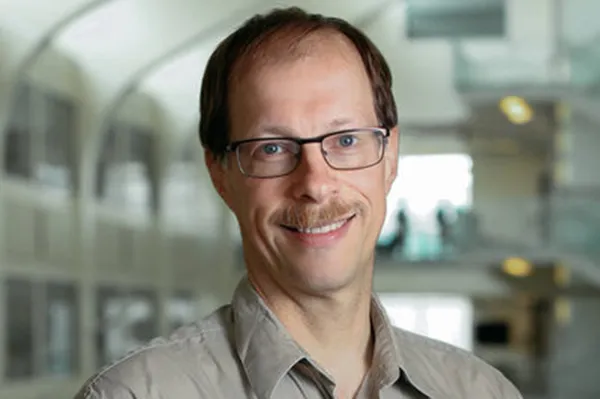
It is hard to believe that I have already been serving as chair of this vibrant department for over two years after taking over from my fabulous predecessor Michael Poirier in summer of 2024. Like Michael, my research is in Biophysics; specifically, I am developing computational models of RNA and DNA structures as well as new algorithms for Genomics data analysis. I started in our department in 2001 as an Assistant Professor and have thus seen it grow and change for a quarter century already! It is such an honor to now be trusted with helping to grow and advance it further.
One of the most exciting developments is the recruitment of many new faculty. Since the last Physics Magazine two years ago we have welcomed Profs. Guido Festuccia, Tyler Gorda, Masaki Oshikawa, Kevin Singh, Zoya Vallari, and Alexander von Hoegen to the department and we are expecting three more (Profs. Christopher Bohrer, Miao Hu and Zeyang Li) to join us in January. That means that come January we will have 10 Assistant Professors in the department, which has not been the case in a long time (if ever)! This has given us an opportunity to strengthen some of our existing research areas but also to explore new connections between areas as well as new directions such as Quantum Information Science.
We also welcomed several new members to our already outstanding staff including our new department manager Rachel Cornell. In total, an excellent team of about 15 research and 25 administrative/instructional staff form the backbone of the department’s missions in research, teaching, and service.
An important measure of excellence of our department is the acclaim our students, postdocs, staff, and faculty receive. Over the last two years there were many such recognitions including top national and international awards, multi-million dollar grants to build cutting-edge national infrastructure, widely highlighted scientific breakthroughs, and recognitions for leadership at all levels. You will find many of them featured in the individual articles in this magazine, and I hope you will enjoy reading about all these amazing accomplishments. Make sure to click on the “Read Full Story” buttons to get all the details.
Not surprisingly, machine learning and artificial intelligence are playing major roles in our department these days. More than half of our faculty are using machine learning and artificial intelligence approaches in their research programs. Prof. Richard Hughes has been teaching a hands-on class on machine learning for many years and we are working on integrating more computation and artificial intelligence into our classes as part of the AI fluency initiative, even as we also had to transition quizzes in our introductory classes back to paper in order to circumvent the less desirable consequences of artificial intelligence use. Several other evidence-based approaches to teaching and learning are being integrated into our introductory classes as well. Because our department teaches about 40,000 credit hours a year, this work has an outsized impact on the education of countless Buckeyes!
While excellence in research and education is crucial, connecting to the wider community is an important pillar of our mission as well. Over the last year or so, three of our faculty (Prof. Chris Orban, Prof. Zeke Johnston-Halperin, and Prof. Jay Gupta) appeared on the WOSU radio station. Our department’s annual “Physics at the Fair” booth run by our outstanding demonstration laboratory coordinator Dr. Christine Jackson allowed a broad cross-section of Ohioans to experience the fun of Physics first hands; even Ohio’s governor got to join the fun during the last two fairs.
Being an excellent Physics department is not a matter of a few outstanding individuals. It is the confluence of excellent faculty, staff, postdocs, graduate and undergraduate students, as well as many supporters from within and outside the university that make all these achievements possible.
So, sit back, get a cup of coffee or tea, relax, and enjoy reading about all the amazing things going on in our department in this Physics Magazine.
Yours
Ralf